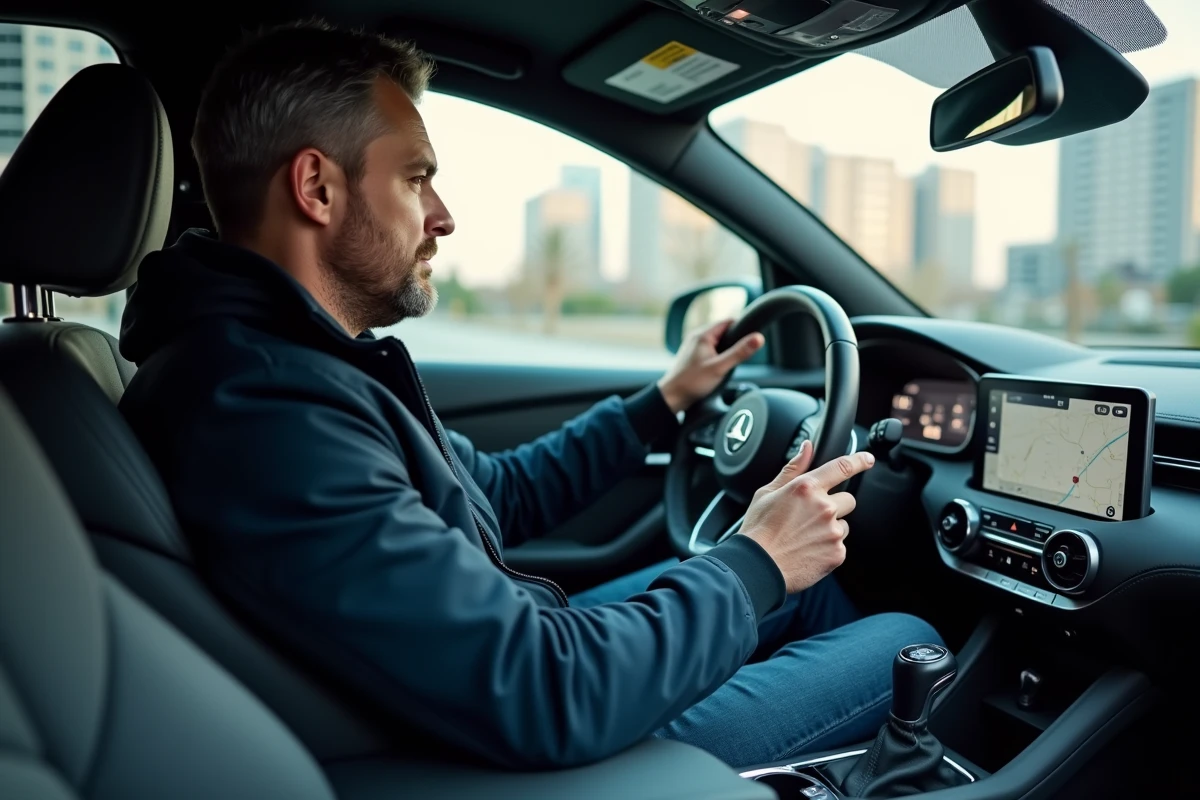
Some Volkswagen models equipped with the lane assist require the automatic activation of this feature at every startup, without saving personalized settings. The deactivation varies depending on the vehicle generation, software interface, or the presence of dedicated physical controls. On some models, the manual deactivation option only appears after several manipulations in the menus, while others require more in-depth intervention via the onboard computer or specific tools. The diversity of embedded systems leads to notable differences in accessing settings and in the daily user experience.
Understanding lane assist: operation, usefulness, and limitations on Volkswagen models
Lane Assist, present on models like the T-Roc, Tiguan, or T-Cross, serves as a valuable aid for maintaining trajectory. Its operation relies on a camera located behind the windshield, capable of detecting the white lines that mark the road. If the vehicle begins to drift without signaling, the system intervenes discreetly: it influences the steering wheel to realign the car. On the highway, during long distances, this assistance limits deviations due to fatigue or moments of inattention.
This technology equips vehicles certified according to WLTP standards, ensuring compliance with consumption and emissions thresholds. Volkswagen has chosen to deploy Lane Assist across a large part of its range, focusing on active safety. On major roads, it acts as a safety net, capable of correcting an unexpected deviation. However, this constant presence does not have unanimous support.
On winding or degraded roads, or during more dynamic driving, Lane Assist can quickly become intrusive. It sometimes intervenes at inopportune moments, correcting trajectories where the driver has full control of the vehicle. Moreover, the fact that it automatically reactivates at every startup adds to the frustration of many users. For those who want to maintain control, deactivating lane assist on Volkswagen becomes a recurring step, according to the details outlined on the dedicated page Deactivating Lane Assist on Volkswagen: user guide – JM Auto.
Why and in what cases to deactivate lane assist? Focus on driver needs
Choosing to deactivate lane assist on a Volkswagen is not a trivial decision. This action stems from concrete experiences behind the wheel. On a mountainous road, for example, the automatic correction can sometimes destabilize driving, imposing unexpected steering movements. Where the assistance aims to be reassuring, it disrupts the trajectory chosen by the driver.
On damaged road surfaces, with faded or irregular markings, the system’s camera hesitates. The result: repeated alerts, imprecise corrections, or even potentially troublesome reactions during delicate maneuvers. Those who frequently drive on such roads prefer to regain total control of their trajectory.
Another scenario: sporty driving. In these moments where the feel of the road takes precedence, any electronic intervention disrupts the pleasure and precision sought. To adapt their vehicle to their driving style, many choose to temporarily deactivate the assistant.
Here are the main situations where deactivating lane assist proves relevant:
- Winding roads: lane assist maintenance is unsuitable
- Poorly maintained roads: line detection is faulty
- Sporty driving: seeking authentic sensations
Underlying this is the possibility of adjusting one’s driving experience. Experienced drivers want to be able to decide, on each trip, whether to activate the assistant or not, to keep the car in their control.

User guide: deactivating lane assist on Volkswagen ID. 4, T-Cross, T-Roc, and other models
Deactivating lane assist on a Volkswagen is done directly from the cabin. On models like the ID.4, T-Cross, T-Roc, or Tiguan, the operation starts with the central screen. Simply navigate to the “Driving Assistants” menu, then select the section dedicated to lane keeping. A simple press allows you to deactivate the “Lane Assist” function, confirmed by a message on the dashboard.
The newest models sometimes offer a physical button, located to the left of the steering wheel or on the center console. This shortcut provides immediate deactivation, without having to go through multiple screens. The advantage: the driver remains focused on the road while adapting the level of assistance to their current needs.
For those who wish to go further, there is another option: using diagnostic software like VCDS or OBDeleven. This involves connecting the tool to the vehicle’s OBD port, launching the procedure, and modifying the relevant parameter. This method is aimed more at advanced users who want to fine-tune the system’s behavior according to their preferences.
One point to keep in mind: lane assist reactivates every time the vehicle restarts. Therefore, the manipulation will need to be repeated on each trip, indicating that the brand prioritizes automatic safety. But this recurrence also highlights drivers’ desire to reaffirm their right to choose in the face of technology. Each person should chart their own course, even when electronics want to take control.