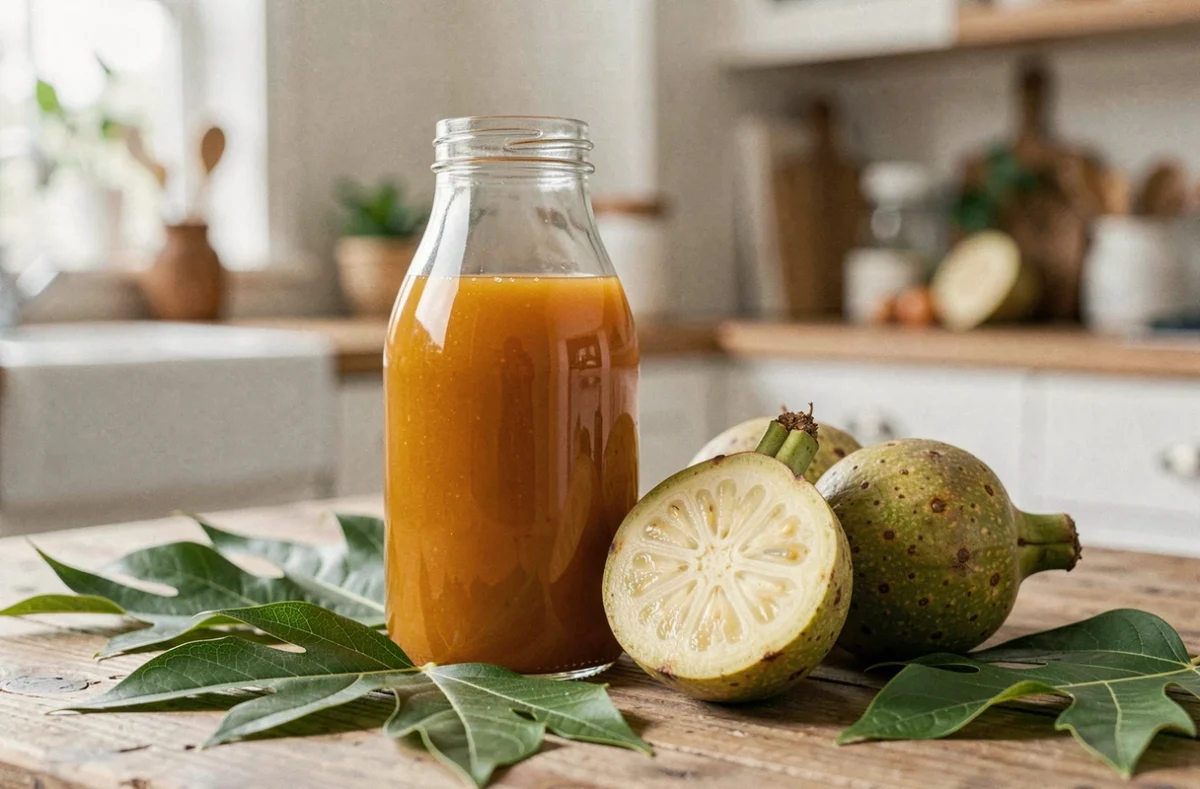
Noni, the fruit of Morinda citrifolia, grows in the tropical regions of the South Pacific and Southeast Asia. Its strong-smelling, bitter-tasting juice has been used for centuries in traditional Polynesian medicine.
Despite its growing popularity in Europe, the NCCIH (the US National Center for Complementary and Integrative Health) states that noni has not been shown to benefit any specific condition in human studies. Laboratory findings alone are not enough to validate the claims often made about this fruit.
Noni juice label: what to check before buying
Spotted a bottle of noni juice at a health food store or online? Before adding it to your basket, turn the bottle around. The label contains information that can fundamentally change what kind of product you’re buying.
First, check which form of noni is used. “Pure noni juice” made from pressed fruit is not the same as a concentrated extract, reconstituted powder, or blend containing several fruits.
In Europe, Regulation (EU) 2015/2283 on novel foods governs these products according to their exact form and intended use. Authorization for one form does not automatically extend to others. Authorization for pasteurized juice does not guarantee that an extract made using a different process has the same status.
Next, check the ingredients list. Some products combine noni with added sugars, flavorings, or other fruit juices (grape, apple) to soften its bitterness. These additions change the nutritional content and dilute the concentration of compounds specific to noni. For more information on the different forms available and to compare ingredients, see https://jus-de-noni.net.
One last thing to look for: the country of origin and any certifications (organic farming, pesticide-free). An organic product grown in French Polynesia or Hawaii offers different assurances from a concentrate with no traceable origin.

Claimed benefits of noni juice: tradition versus scientific evidence
Noni has many traditional uses. In Polynesia, the fruit was applied to the skin or consumed to support the body’s natural defenses, aid digestion, or relieve joint pain. These uses, passed down orally, have fueled sometimes exaggerated marketing claims.
What laboratory studies show
In vitro research and animal studies have identified compounds in noni with antioxidant and anti-inflammatory properties. These findings are real, but they point to potential—not a clinically proven effect in humans.
Laboratory findings are not enough to support detox or immune-boosting claims. The NCCIH is clear on this point. To date, no clinical study has proven that noni juice offers a therapeutic benefit for any specific disease.
What noni is not
Noni juice is neither a cancer treatment nor a substitute for medical care. In a research project on herbal medicine and breast cancer, the University of Angers noted no toxicity or interactions with anticancer drugs at recommended doses, while also emphasizing that further studies are needed to confirm any potential use in supporting immune function.
Precautions and contraindications for noni juice
This is where the article takes a practical turn. Noni is not harmless for everyone, and three points deserve particular attention.
- Potassium content: noni juice contains a significant amount of potassium. People with kidney disease or following a low-potassium diet should consult a healthcare professional before consuming it. The NCCIH also recommends caution when taking medications that increase blood potassium levels.
- Drug interactions: caution is advised with medications that lower blood pressure or may affect the liver. The possibility of combined effects makes it important to seek medical advice beforehand.
- Reported but unconfirmed liver risk: cases of liver problems have been reported after consuming noni juice or tea. The NCCIH notes that it is not known whether noni was the cause. As early as 2006, the EFSA concluded that the cases reviewed did not provide convincing evidence of a causal link with the juice.
Taking regular medication? Talk to your doctor or pharmacist before adding noni juice to your routine. This advice applies to all plant-based dietary supplements.
Ways to consume noni: juice, capsules, or powder
Noni is available in several forms. Each has its own characteristics.
Pure noni juice is generally consumed in small amounts, diluted in water or mixed with another juice to mask its bitterness. Manufacturers often recommend one to two tablespoons a day, but serving sizes vary by brand.
Noni capsules contain fruit powder or a dry extract. They’re suitable for people who dislike the taste. Here too, the concentration of active compounds depends on the manufacturing process, making it difficult to compare products without carefully reading the labels.
Noni oil is also available and is used on the skin in some traditional practices. Its use remains uncommon in Europe and is not well documented scientifically.
Whatever form you choose, look for a product whose label provides full details of its ingredients and manufacturing process. A product that is unclear about its ingredients or origin is not one you should trust.
Noni juice and European regulations: what you need to know
Noni’s regulatory status in Europe depends on the exact form of the product. Pasteurized fruit juice from Morinda citrifolia is listed in the European Novel Food Catalogue as authorized, provided it meets certain production requirements.
An extract made using a different process, or a powder made from leaves rather than fruit, may require a separate assessment. The word “noni” on the packaging does not guarantee a uniform regulatory status.
This distinction has practical implications for consumers: two products labeled “noni” may be subject to different regulatory frameworks. Checking whether the product states that it complies with Regulation (EU) 2015/2283 is a good indicator of reliability.
Noni juice remains an interesting product nutritionally, rich in plant compounds that researchers are studying. For most healthy adults, including it as part of a varied diet is not a problem.
However, therapeutic claims go beyond what science has confirmed to date. Reading the label, checking the product’s form, and consulting a healthcare professional if in doubt remain the three most useful steps to take before buying.